We live in an apartment complex built in 1994. The layout features external cement-slab staircases that lead up to the second-story suites. Joe and I just so happen to inhabit an apartment on the second floor.
About a year into our stay, we noticed that the first cement stair was crumbling. It had long been exposed to the Indiana elements, and as snow and rain pelted its gritty surface, parts of the stair began chipping away. We called on our maintenance man to replace it with fresh cement.
A bit of time passed, and the second step began cracking. Day after day, the crack grew until half the stair crumbled to the pavement below, prompting another call to the maintenance man. This process continued over and over -they’d fix the second step, then the third one would crumble. They’d fix the third step, and the fourth one would crumble. Onto the fifth, and the sixth, and so forth.
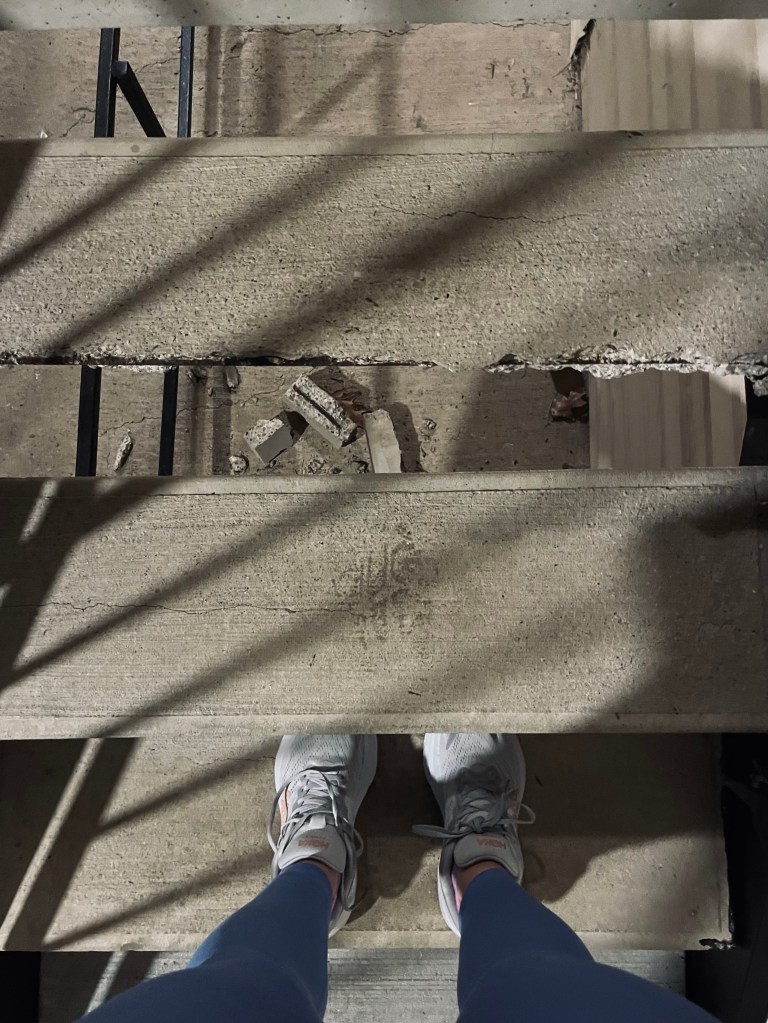
When friends or family would come visit, Joe would try to greet them before they began their ascent. “Be careful of the fourth step!” “The fifth step is crumbly!” Many people — especially our protective fathers — surely felt tempted to scorn the unsafe stairs. I would shrug with misplaced optimism: “It’s a metaphor.”
The gradual progression of step erosion seemed to mirror the past year of our lives. Step 1 crumble: Mom was diagnosed with cancer. Step 2 crumble: That cancer caused a stroke. Step 3 crumble: We struggled to conceive. Step 4 crumble: Conceived, and yet the baby did not survive. As soon as we dealt with one crumbling step of life, the next one began to crack. We could hardly keep up with all the destruction.
But in a very literal sense, we couldn’t let ourselves get so bogged down with our crumbling steps that we didn’t continue stepping up to the next one. If we did, we’d never make it home. Sometimes we had to skip over steps. Sometimes we had to lunge across a couple steps as they were slowly being repaired. But we had to keep stepping up. It was our only option.
This language reminds me of one of the most helpful and practical pieces of advice I have read — no surprise, by Elisabeth Elliot. In her book Suffering is Never for Nothing, she pleads with her readers:
“Do the next thing. I don’t know any simpler formula for peace, for relief from stress and anxiety than that very practical, very down-to-earth word of wisdom. Do the next thing. That has gotten me through more agonies than anything else I could recommend.”
It has earmarks of our stair-ascending slogan: Keep stepping up. Keep climbing. Keep doing the next thing. When my mom died, I wanted to bury myself in blankets and grief and stay there forever. I wanted to block out the world and never leave my bed. This became all the more true when we lost our baby, too. But I found it strangely healing to force myself up and do the dishes. To go to work. To prepare dinner and share a meal with friends. To do the next thing.
Many people, in attempts to be encouraging, offered advice like, “let yourself stay in bed for as long as you need,” or “don’t be afraid to take a week off to wallow.” And there’s a time for that, I’m sure of it. But what is truly helpful? What truly allows you to take the next step toward healing — toward Home? Doing the next thing. Stepping out of bed and up on the staircase, singing worship music while plucking eyebrows, scrubbing toilets, folding laundry. Doing the next thing.
None of these tasks are significant acts or noteworthy accomplishments. But they are necessary perspective-shifters that provide something to focus on besides our present sorrow. Showing up at church. Cleaning out the closet. Helping a friend move, and finding that lifting the burdens of others lifts some of our heaviness too. In the same way all track coaches implore you to keep moving after a race, this idea of doing the next thing is that little-by-little movement that keeps you from getting stuck. It’s the metaphorical lactic-acid reliever after running the hardest race of your life.
Do the next thing. Climb the crumbling stairs. Take step after step for the long journey home.
An old Saxon poem in an English parsonage reads,
“Do it immediately, do it with prayer, do it reliantly, casting all care. Do it with reverence, tracing His hand who placed it before thee with earnest command. Stayed on omnipotence, safe ‘neath His wing, leave all resulting, do the next thing.”
My encouragement for you (and me) today: Do the next thing.
 House on the Rock
Leave a comment